
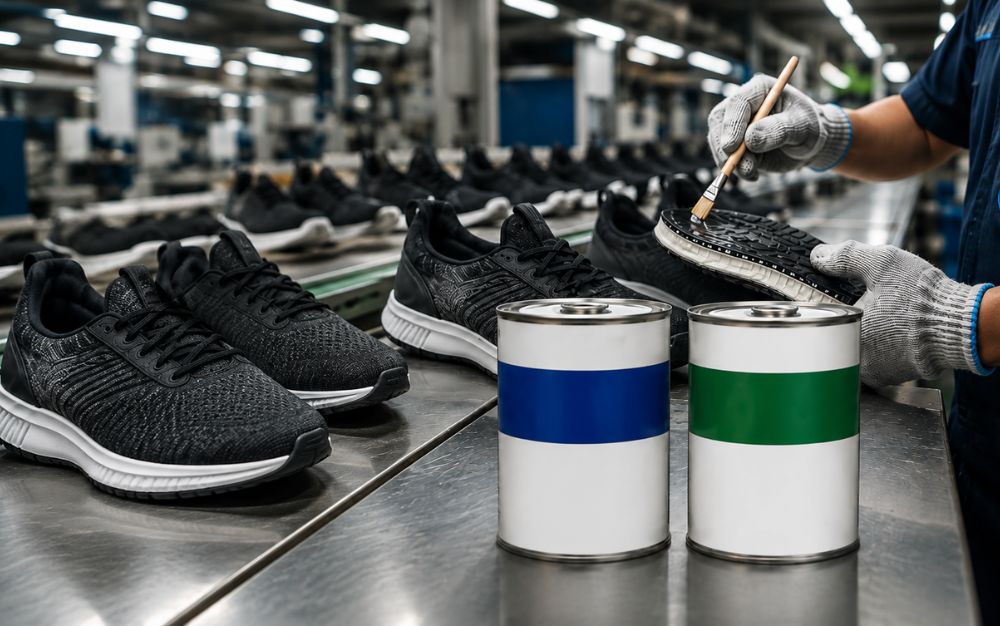
A footwear manufacturer in Selangor was facing bonding issues between rubber outsoles and synthetic or fabric upper materials during production line assembly.
Finished shoes looked acceptable during visual checks, but some pairs failed during flex and peel testing. The team wanted to review its adhesive choice and production approach to reduce recurring bonding issues during footwear assembly.
The Challenge: Sole Bonding Issues Found After Quality Checks
Sole separation was difficult to catch during normal line inspection. Several pairs passed visual checks, then failed during downstream flex and peel testing after production time and materials had already been used.
The production team was experiencing inconsistent results across different materials and production runs. This created additional rework and made the bonding process harder to manage consistently across shifts.
The manufacturer approached Affluent Cycle to review its adhesive requirements and explore a more suitable option for its footwear production.
Our Solution: LEM-ON GA and LEM-ON PRIMER for Footwear Assembly
Product image placement: Add product image cards for LEM-ON GA (3KG) and LEM-ON PRIMER (3KG) under this section. Link the product cards to the product page if available, or to the footwear adhesive service page.
Affluent Cycle reviewed the materials used in the footwear assembly process and discussed an adhesive option suited to the manufacturer’s production requirements.
LEM-ON GA (3KG) was recommended as the shoe glue because it offered higher viscosity, stronger initial tack and steadier open time during line assembly. This helped operators apply, position and press components within a more predictable working window.
LEM-ON PRIMER (3KG) was added for synthetic upper materials that needed surface preparation before adhesive application. The primer helped improve surface readiness, allowing the adhesive system to bond more consistently on difficult substrates.
The team also provided practical guidance on product handling and application so operators could follow a clearer process during production.
The Implementation Process
Material samples and the existing production process were reviewed before the adhesive was introduced on a smaller scale.
The manufacturer then assessed how the product fitted into its normal workflow before proceeding with regular supply.
The Result: More Stable Bonding and Lower Rejection Risk
The LEM-ON GA and LEM-ON PRIMER system helped the manufacturer stabilise sole and upper bonding across production shifts.
The manufacturer established a clearer adhesive approach for its footwear production. Operators had more consistent guidance to follow, and the production team was better able to manage adhesive use across different shifts.
The technical advisory process also gave the production and quality teams a clearer explanation of why bonding failures had occurred and how the updated adhesive system addressed the issue.
What Made the Difference?
The project focused on understanding the manufacturer’s materials and production requirements before selecting an adhesive option. This gave the team a clearer basis for managing adhesive use during footwear assembly.
A proper match between LEM-ON GA, LEM-ON PRIMER and the manufacturer’s material surface helped improve bonding consistency during assembly.
Footwear manufacturers facing similar bonding issues can review Affluent Cycle’s footwear adhesive support or contact us to discuss production line requirements.
