
Many manufacturers only notice adhesive waste when it starts affecting production costs. Extra glue usage, weak bonding, rejected parts, messy application, and repeated touch-ups can quietly slow down output and eat into margins.
Adhesive waste reduction starts with choosing a formulation that suits your substrate, application method, production speed, and Malaysia’s working environment. A better match helps your team bond faster, waste less, and maintain consistent product quality.
This guide looks at the common causes of adhesive waste, the factors to check before choosing an adhesive, and the value of working with a local adhesive manufacturer that can advise, test, and adjust solutions based on your actual production needs.
Why Adhesive Waste Is a Bigger Problem Than Most Businesses Realise
Adhesive waste can quietly affect production in many ways. Rejected products, repeated touch-ups, damaged materials, messy application, and slower output all add cost to daily operations.
In high-volume production, a small bonding issue can become expensive fast. Adding extra adhesive may feel like a quick fix, yet it often creates more mess, longer drying time, and higher material usage.
| Application Type | Recommended Adhesive | Key Benefit | Waste Risk If Wrong |
| High-speed packaging | Hot melt adhesive | Fast set, high throughput | Stringing, excess usage |
| Electronics assembly | UV-cure or epoxy | Precision bond, thermal stability | Delamination, rework |
| Foam and textile bonding | Water-based or SBS contact | Flexible, substrate-safe | Poor adhesion, peeling |
| Metal-to-metal structural | Polyurethane or modified epoxy | High strength, durability | Bond failure, part scrap |
A Malaysian electronics assembler, for example, dealing with adhesive delamination just 2% of the time across thousands of units per day faces significant cost exposure. The solution is rarely to apply more adhesive. It is to apply the right one.
A better adhesive match helps your team reduce waste, improve bonding consistency, and keep production moving smoothly.
Contact Affluent Cycle Industries for expert guidance on the right adhesive solution for your production needs.
4 Key Factors Driving Adhesive Waste in Manufacturing
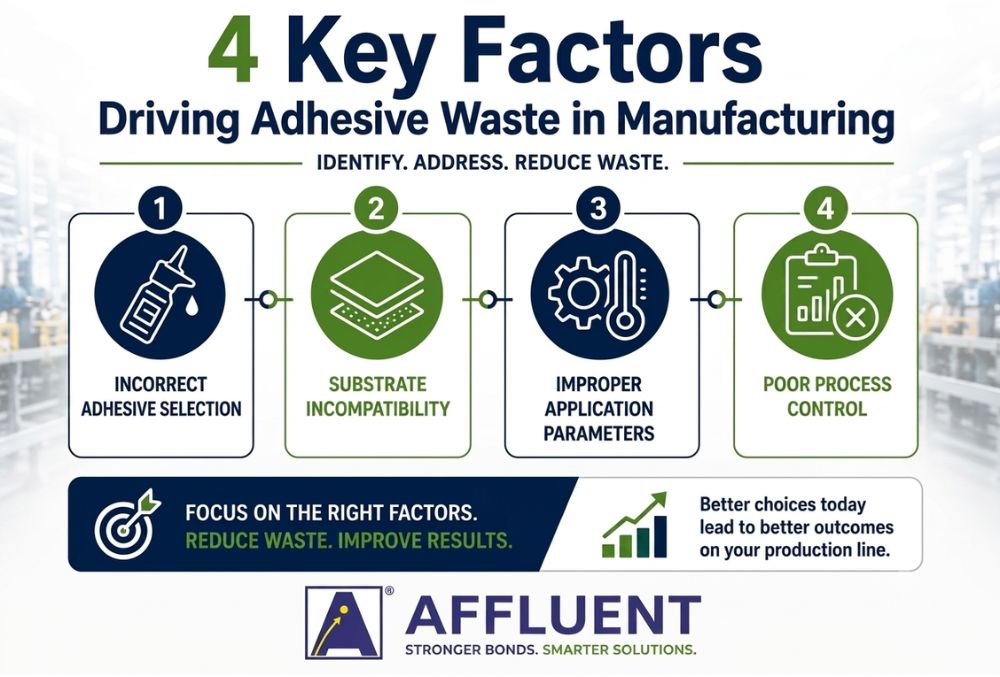
Adhesive waste often starts long before rejected products appear on the line. In many cases, it comes down to a few practical issues that affect bonding quality, material usage, and production flow.
1. Mismatched Adhesive Type for the Application
Using a general-purpose product where a specialised formulation is required leads to weak bonds, open-time failures, and inconsistent results.
For instance, applying a hot melt adhesive in a high-heat environment without checking thermal resistance specifications will result in bond degradation and rework.
2. Poor Substrate Compatibility
Adhesives interact differently with plastics, metals, rubbers, foams, and composites.
When there is a mismatch between adhesive chemistry and substrate surface energy, bonding is unreliable.
This is a common source of rework in Malaysian manufacturing, particularly in industries handling mixed-material assemblies.
3. Incorrect Application Parameters
Even a well-specified adhesive will underperform if applied outside its recommended temperature range, open time window, or with inadequate pressure.
Consistency in application parameters is essential, and selecting adhesives that are forgiving within realistic process tolerances reduces waste substantially.
4. Bulk Purchasing Without Shelf Life Management
Ordering large volumes to reduce unit cost often backfires when adhesives expire before use.
Proper adhesive selection includes matching order quantities to actual consumption rates, factoring in shelf life, and working with suppliers who offer manageable packaging formats.
How to Reduce Adhesive Rework in Manufacturing Through Selection
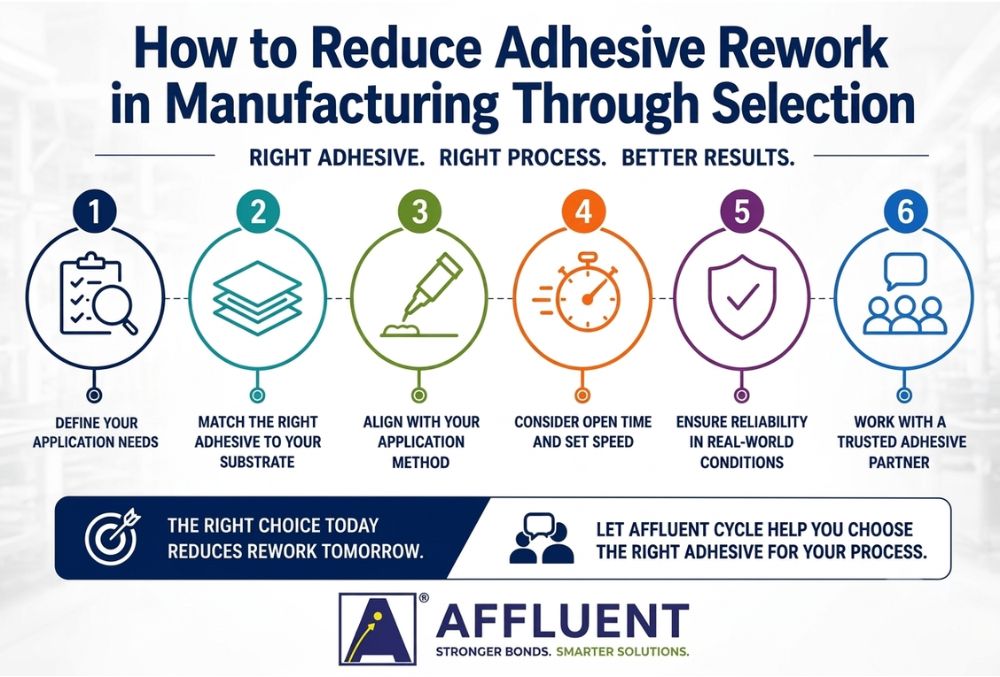
Adhesive rework usually happens when the product, material, and application method are not properly matched. A better selection process helps your team avoid repeated fixes, wasted adhesive, and bonding issues before production begins.
1. Define Your Bond Requirements Precisely
Before selecting an adhesive, document what the bond actually needs to withstand: temperature range, chemical exposure, mechanical stress, flexibility requirements, and cycle time constraints.
Vague requirements lead to under- or over-specified adhesives, both of which generate waste.
2. Match Adhesive Chemistry to Your Substrates
Work with your adhesive supplier to verify compatibility between the adhesive formulation and your specific substrates. Surface energy, porosity, and pre-treatment all affect bond strength.
This step alone eliminates a large proportion of adhesive rework in manufacturing.
3. Optimise Application Method and Equipment
Manual bead application, pneumatic dispensing, roll coating, and hot melt systems all behave differently with different adhesive viscosities and working times.
Aligning your application method with the adhesive specification reduces over-application and inconsistent coverage. Thinner, more uniform adhesive films often outperform heavier applications for the same bond strength.
4. Pilot Test Before Full Rollout
Run controlled trials comparing candidate adhesives across your actual production conditions before committing to volume. Test for bond strength, open time performance, and application consistency.
This investment in evaluation prevents costly switches mid-production.
5. Partner With a Manufacturer Who Understands Your Process
Generic adhesives sourced without application context rarely deliver optimal performance.
Working with an adhesive manufacturer in Malaysia, Affluent Cycle Industries, gives you access to technical formulation expertise, local logistics, and customised products designed around your specific process requirements.
Speak with Affluent Cycle Industries technical team about a pilot test or custom formulation for adhesives.
Reduce Rework with Affluent Cycle Industries Adhesive Expertise
Affluent Cycle Industries helps manufacturers choose, adjust, and produce adhesive solutions that fit production needs. You get practical support through our glue advisory on bonding performance, material suitability, application method, and production flow.
Based in Selangor, Affluent Cycle Industries supplies industrial adhesives for sectors such as electronics, furniture, automotive components, packaging, and related manufacturing lines. Our team can review your requirements and recommend adhesive options that help reduce rework, overuse, rejected output, and unnecessary production delays.
Businesses that need custom formulations can also work with Affluent Cycle Industries through toll manufacturing. This allows you to produce adhesives under your own brand or specification of private label adhesive, without setting up an in-house blending facility.
Manage Adhesive Efficiently Before It Costs More
Adhesive waste often starts before production begins. A mismatched product can lead to weak bonding, excess usage, rejected output, and repeated rework.
Affluent Cycle Industries helps manufacturers in Malaysia review their adhesive needs, match the right formulation to the right application, and support production through reliable local supply.
Our team also provides toll manufacturing solutions for businesses that need custom adhesive production under their own brand or specification.
Speak to Affluent Cycle Industries today and get practical adhesive guidance for your production needs.
Frequently Asked Questions (FAQs)
Adhesive waste reduction focuses on lowering rejected output, excess glue usage, and rework by using adhesives that match your materials and production process.
Affluent Cycle Industries commonly sees rework caused by incorrect adhesive selection, unsuitable application methods, and bonding conditions that do not match the production environment.
Yes, the wrong adhesive can lead to higher material usage, repeated touch-ups, slower production, and damaged substrates that increase overall operating costs.
Manufacturers can improve adhesive efficiency by reviewing substrate type, drying time, application method, and bonding performance before scaling production.
Yes, Affluent Cycle Industries supports custom adhesive manufacturing based on your bonding requirements, production setup, and application needs.
Yes, our team can review your current adhesive usage and recommend more suitable solutions to reduce waste, rework, and bonding issues.
